Be yourself; Everyone else is already taken.
— Oscar Wilde.
This is the first post on my new blog. I’m just getting this new blog going, so stay tuned for more. Subscribe below to get notified when I post new updates.
Interesting Astronomy Snippets
Be yourself; Everyone else is already taken.
— Oscar Wilde.
This is the first post on my new blog. I’m just getting this new blog going, so stay tuned for more. Subscribe below to get notified when I post new updates.


Many are familiar with the concept that the Moon creates high and low tides on Earth, but few know that the Sun also plays a role in the process. Tides are formed from the gravitational forces of the Sun and Moon pulling on the Earth differently in different places due to variations in distance. The closest part of the Earth to the Sun/Moon is tugged more so than the center of the Earth. This causes the Earth to bulge slightly, in the same way a rubber band does when tugged on one side. The Moon is the much more dominant party in tidal affairs, despite its inferior gravitational force. This is because it is much closer to the Earth, so the differences created in its gravitational fields are much more pronounced compared to the Sun. Nonetheless, the Sun’s tidal force is still felt, especially when it directly contrasts or works alongside that of the Moon.
Spring tides occur when the Sun and Moon work in perfect harmony with each other to produce higher high tides and lower low tides. Such occurs when the Moon is in the new or full phase and the Sun and Moon are both tugging on Earth in the same directional axis. Their efforts become added and a conjuncted, more powerful force is created. If the spring tide occurs one of the equinoxes the tide becomes even more polarized as the Sun forms a straighter line than usual with Moon and Earth at the equator. Neap tides on the other hand refer to the weaker tides which occur when the Sun and Moon are working against each other. This happens when the Moon forms a ninety degree angle with the Sun relative to the Earth (first and third quarter phases). Neap tides occur about 7 days after a spring tide.
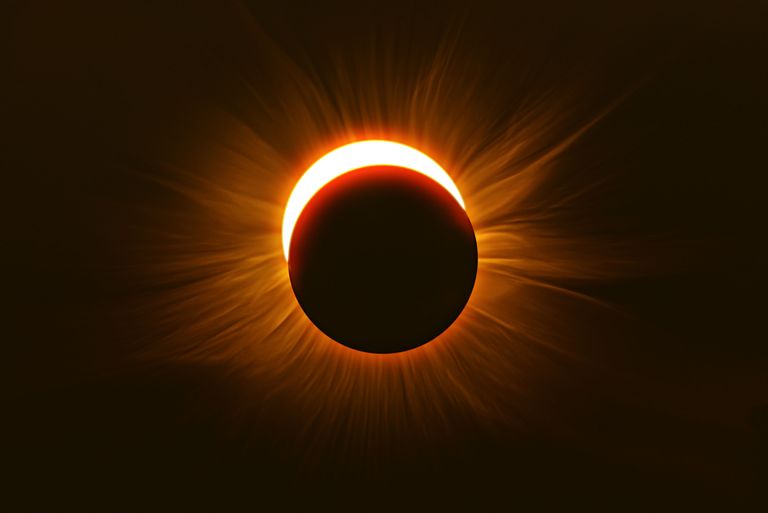
A solar eclipse occurs when the moon comes in between the path of sunlight and the Earth, casting a shadow on the Earth. Solar eclipses in general are quite rare (only a couple a year), but the moon’s shadow only covers a small portion of the Earth so seeing one is an amazing opportunity. A total solar eclipse, in which the sun is fully blocked by the moon, is even more rare occurring about every year and a half somewhere on Earth. One particular spot on Earth can expect to see a solar eclipse for just a few minutes every 375 years. The next solar eclipse will be on June 21, 2020 and can be seen in a tight strip spanning Africa and Asia. A total solar eclipse will occur on December 14, 2020 and be visible from parts of Chile and Argentina.
A lunar eclipse occurs as the Earth gets in the way of sunlight hitting the moon. The moon turns dark as the Earth’s shadow covers it up. Earth’s atmosphere can make the moon appear red during the eclipse as other colors are absorbed. Lunar eclipses are also very rare due to the tilt of Earth axis causing the Earth, sun, and moon to not line up perfectly every month. Penumbral lunar eclipses are more common than total lunar eclipses and occur when the moon crosses through the large and faint outer part of Earth’s shadow. The next lunar eclipse will be visible from June 5-6, 2020 across Asia, Europe, Africa, and Australia. A total lunar eclipse will be visible on May 26, 2021 in parts of the western US, western South America, and south-east Asia.

RIP Kobe. He was an inspiration to countless people and was part of the reason I started watching basketball.
This is an example post, originally published as part of Blogging University. Enroll in one of our ten programs, and start your blog right.
You’re going to publish a post today. Don’t worry about how your blog looks. Don’t worry if you haven’t given it a name yet, or you’re feeling overwhelmed. Just click the “New Post” button, and tell us why you’re here.
Why do this?
The post can be short or long, a personal intro to your life or a bloggy mission statement, a manifesto for the future or a simple outline of your the types of things you hope to publish.
To help you get started, here are a few questions:
You’re not locked into any of this; one of the wonderful things about blogs is how they constantly evolve as we learn, grow, and interact with one another — but it’s good to know where and why you started, and articulating your goals may just give you a few other post ideas.
Can’t think how to get started? Just write the first thing that pops into your head. Anne Lamott, author of a book on writing we love, says that you need to give yourself permission to write a “crappy first draft”. Anne makes a great point — just start writing, and worry about editing it later.
When you’re ready to publish, give your post three to five tags that describe your blog’s focus — writing, photography, fiction, parenting, food, cars, movies, sports, whatever. These tags will help others who care about your topics find you in the Reader. Make sure one of the tags is “zerotohero,” so other new bloggers can find you, too.

 Rehan's Astro Blog